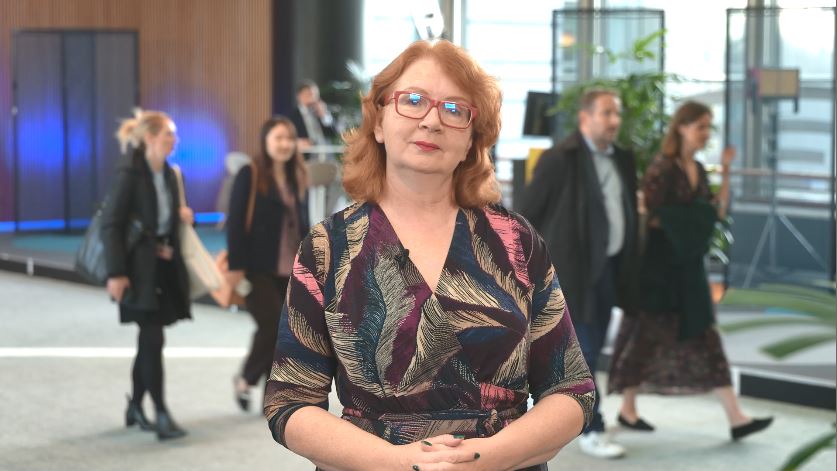
Committee debates, working on documents, scandals, intrigues, investigations – another week in the life of an MEP, shuttling between Tallinn and Brussels.
1
Monday began, as usual, with a 10-minute broadcast on Radio Maximum, where we discussed rising oil prices and everything else related to the war in Iran. I then went to a meeting with pupils at Tallinn’s Läänemere Gymnasium. The pupils pleasantly surprised me, especially Artem, a Year 9 pupil, who knew literally everything about everything – right down to the width of the Strait of Hormuz – so I took the liberty of rewarding the boy with a trip to Brussels. I then flew to Brussels – and worked throughout the long, connecting flight, as the following day promised to be very busy.
2
Tuesday morning began with a vote in the Committee on Employment and Social Affairs (EMPL). Then, at a joint meeting of EMPL and the Special Committee on the Housing Crisis (HOUS), there was an exchange of views with European Commissioner for Energy Dan Jørgensen. I was particularly interested in whether the European Commission intends, in some form, even if only temporarily, to bring the cost of CO2 emission allowances, which directly affect our electricity bills, under control. Dan Jørgensen replied that it does.
At a meeting of the Renew Europe group’s bureau, we met with another European Commissioner, Stéphane Séjourné, who is responsible, among other things, for industrial strategy. The topic is, to put it mildly, highly topical – given the strategic challenges facing Europe head-on. Take the oil price crisis, for instance. How can we help EU industry? One idea is to allow state aid, which, as a general rule – let me remind you – is prohibited, so that countries do not give their enterprises unfair competitive advantages. Germany, for example, periodically applies to the European Commission – and receives such authorisations (for instance, in February a €3 billion state aid package for green companies was approved).
During the break, I gave an interview to Vikerraadio. Then there was a meeting of the EMPL coordinators, where we discussed the work plan for the next six months. After that came the main event of the day – for me – the trilogue.
3
The trilogue is the most important stage in the life of any European legislative proposal: three-way negotiations between representatives of the European Commission, the European Parliament and the Council of the EU. I attended this trilogue for the first time as the main rapporteur, and my report on the protection of adults was discussed. It was previously called ‘Protection of Vulnerable Adults’, but it was decided to remove the word ‘vulnerable’ for reasons of political correctness.
This concerns people who are recognised as being partially or fully incapacitated. For example, you move to another EU country and take your elderly grandmother, who suffers from dementia, with you. The rules for dealing with such people vary greatly across EU countries, and in your new location, your grandmother may be placed in a care home without her (or your) consent. Meanwhile, there is the UN Convention on the Rights of Persons with Disabilities, which essentially requires that, where possible, the views of such adults be taken into account. So we face two tasks: to harmonise all such rules across all EU countries – and to do so in line with the UN Convention.
On the European Commission side, the issue is overseen by Michael McGrath, Commissioner for the Rule of Law and Consumer Protection, and we have almost complete mutual understanding with him, as well as with representatives of the Council. Alas, we had to remove from the Commission’s proposal the idea of creating a single European register of such individuals – many countries are opposed to it. In particular, Germany, simply because they view digital registers with suspicion there, preferring old-fashioned paper records. (The various systems we have here in Estonia arouse enormous mistrust among the Germans.) Otherwise, we were in agreement. This was a so-called political trilogue, at which fundamental issues were discussed. The next one will be technical, bringing together officials, after which we will meet again to finalise the outcome. Then the European Parliament will vote – and the report will become EU law.
4
On Thursday, as the Renew Europe coordinator for the EMPL Committee, I took part in a coordinators’ meeting where we were literally like the Cossacks writing a letter to the Turkish sultan. Only we were writing to our colleagues in the REGI and AGRI committees, asking them to take our calls into account regarding social welfare in the draft EU budget. I wrote about this in more detail here.
I then gave an interview, not to the media, but to two master’s students from the Department of Political Science at the University of Copenhagen who are writing their theses on EU migration policy. We discussed the migration package, which the previous European Parliament had rushed through at the end of its last term, fearing – as it now turns out, quite rightly – that the next Parliament would be far more radical, including on the issue of migrants. And so it proved: in this session, the Parliament approved a list of countries to which migrants can be ‘safely’ deported without giving them the opportunity to apply for asylum – and at the same time, endless resolutions are being passed regarding human rights violations in those very same countries. The situation is, let’s be frank, outlandish.
After a meeting of shadow rapporteurs on the dossier concerning the establishment of a European fund for regional development, I met with pupils from the Hugo Treffner Gymnasium in Tartu. It is always a pleasure to talk to intelligent children. Among other things, the pupils asked why, if we had joined a union of sovereign states, was the EU is now moving increasingly towards a federation – surely that is a bad thing? I said that it is not such a bad thing: all the criticisms levelled at the EU by opponents of a federation arise precisely because we are not a federation.
5
Furthermore, on Wednesday, Thursday and Friday, I spent quite a few hours in the office and on planes working through a report. As I have already mentioned, in the Committee on Legal Affairs (JURI) I am the shadow rapporteur on the European Commission’s proposal to create a single pan-European commercial register. The Estonian Ministry of Justice is opposed to this and cites financial arguments. My advisers and I questioned the Ministry of Justice in detail about this, studied the European Commission’s position – and it seems I have found a certain contradiction here: perhaps our Minister of Justice is mistaken. Among other things, I find it strange that, although such systems exist in many EU countries, not many countries are objecting to a single EU register.
Finally, on Thursday I recorded a new ‘Brussels Diary’ about how the ‘sensation’ regarding alleged Kremlin propaganda, which was hyped up by Propastop and the Prime Minister, reached the European level – and perhaps worked in favour of that very propaganda.