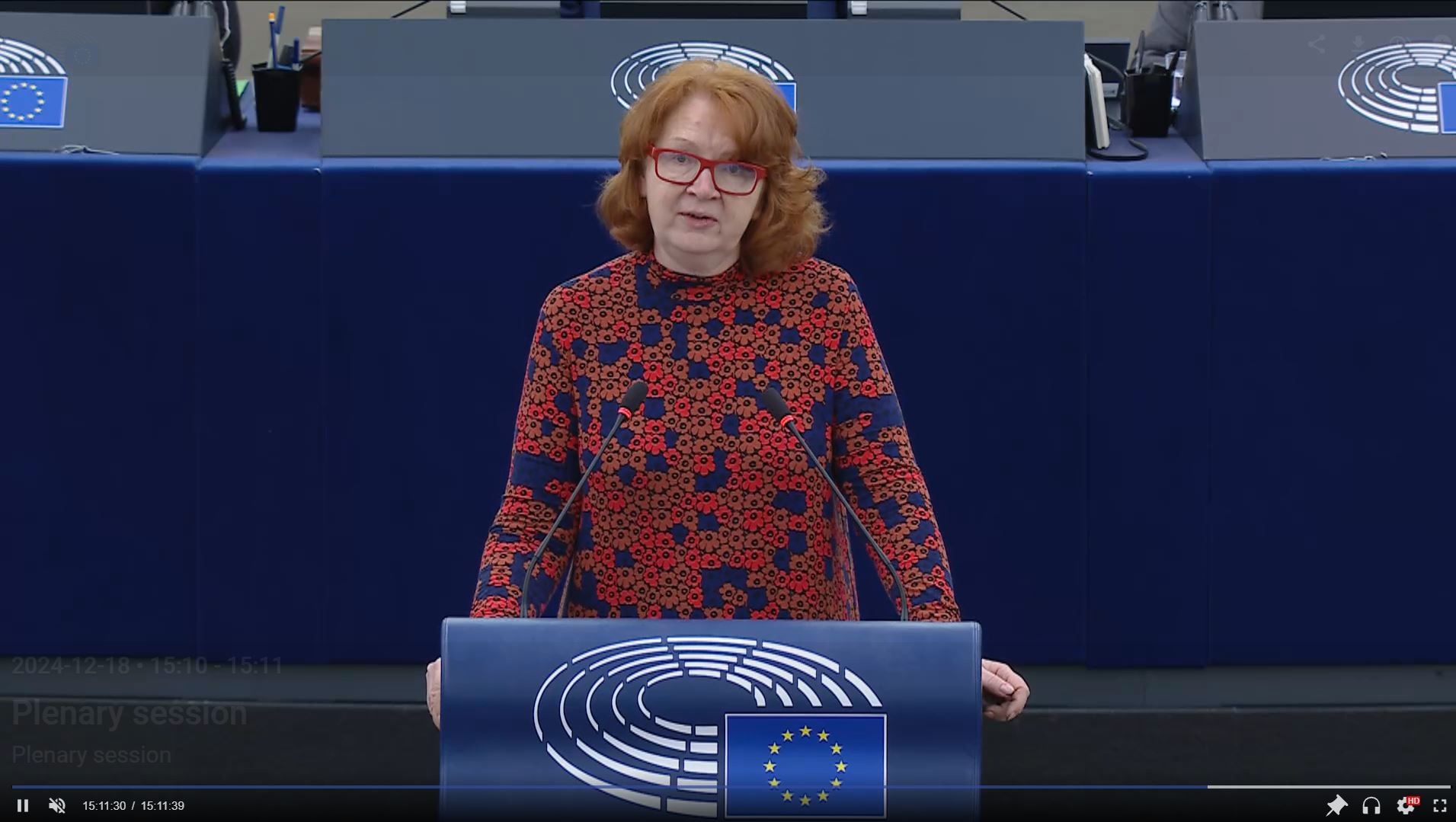
In the new year, I decided to try a new format – a brief overview of my work for the week. Just in case anyone thinks I'm doing nothing in the European Parliament. So, here's my week...
1
Next Tuesday, the European Parliament plenary session in Strasbourg will vote on the report ‘The Just Transition Directive in the World of Work’. Therefore, last Tuesday, as the main rapporteur, I presented the report to my colleagues in the Renew Europe group at a working group meeting.
We have different types of reports, including those drawn up on the initiative of the European Parliament, which is the case here. These, in turn, are divided into legislative and non-legislative reports. The European Commission is obliged to consider such a report in either case, but the obligation to adopt it arises only if the report is legislative. Of course, we want our report to be legislative so that a Just Transition Directive is guaranteed to be adopted, which would make the transition truly ‘just’. In particular, it would oblige the state to create more jobs, give money from the EU Emissions Trading System to regions affected by the transition and agree on restructuring with employees’ representatives. In Estonia this would certainly have a direct positive impact on Ida-Viru County.
But not everyone agrees with us. On the eve of voting on any important report, there is active lobbying. Trade unions are on our side (the report was prepared jointly with the European Trade Union Confederation, ETUC), while employers (Business Europe), for example, are against it. This report is also not very convenient for the European Commission, which organised the ‘just transition’ in its current form – no one likes self-criticism and working on mistakes. Finally, an official course has been set to ‘simplify’ European legislation, and many sensible initiatives are being stifled under this pretext. We must use every opportunity to convince our colleagues to vote ‘yes’. That is what we have been doing all week.
2
On the same day, there was a short meeting of the European Parliament's Trade Union Support Group (of which I am co-chair). We discussed the report on the Just Transition Directive and the new revision of the Dangerous Substances Directive in relation to the labour market. The aim of the latter is clear: we want to protect workers from occupational diseases.
3
Tuesday, 13 January, was a busy day: my political group organised the Renew Europe Global Europe Forum 2026. Foreign policy was discussed there, in particular the situation with America and Greenland, and the NATO Secretary General spoke (see an excerpt from his less than encouraging speech on my social media: FB, Instagram, TT).
On Wednesday, we also had a discussion at our political group meeting on how to deal with America and Trump.
4
On Wednesday, an extraordinary working group on the MFF (the seven-year EU budget) took place. By Friday, the committee coordinators – and I am the coordinator for the Committee on Employment and Social Affairs (EMPL) and the Special Committee on the Housing Crisis in the EU (HOUS) – had presented proposals for what we would like to change in the budget. My colleagues and I see three main social problems in the draft EU budget:
1) the termination of funding for the Just Transition Fund (which is precisely why we need the directive I mentioned above);
2) the termination of funding for the Globalisation Adjustment Fund (which can provide money to a country when there are mass redundancies related to globalisation, including the green agenda; unfortunately, Estonia has rarely used its opportunities);
3) social funds in the new budget are not going to be earmarked for specific purposes, which, of course, does not suit us – the government will spend this money on anything but workers.
We have submitted our proposals. Next week we will meet with the main budget rapporteur to discuss how and where to move forward.
5
On Thursday, there was a meeting of the EMPL Committee. I spoke at the request of my colleague, French MEP Grégory Allione, who is the rapporteur on the directive on hazardous substances in the context of the labour market, a former firefighter and an expert on the topic. Grégory was unable to attend, so I read out his comments on the text of the report.
One of the emerging problems is related to cobalt. The European Commission wants to make an exception for it because it is important for defence, but trade unions insist that it is a highly probable carcinogen. Defence is a priority today, but we will see.
6
This week, my office received a letter, which I cannot discuss in detail, but it will definitely serve as the basis for at least a request. The problem is related to the lack of coordination between rescue services within the EU. For example, you are talking to a friend in another country via the internet, and a situation arises where only you can save your friend by contacting the local rescue services. Today, it seems impossible to do this quickly.
A unified security system is also part of European unity. Therefore, as co-chair of another parliamentary group – Intergroup on Mental Health – I am preparing a draft letter to the Commission. Our group must raise the issue firmly: 112 is not just a pan-EU phone number; it must be backed up by a functioning structure for the instant exchange of information.
These are my highlights for the week. Please write what you think in social networks or by e-mail (info@yanatoom.ee)– and take care!